
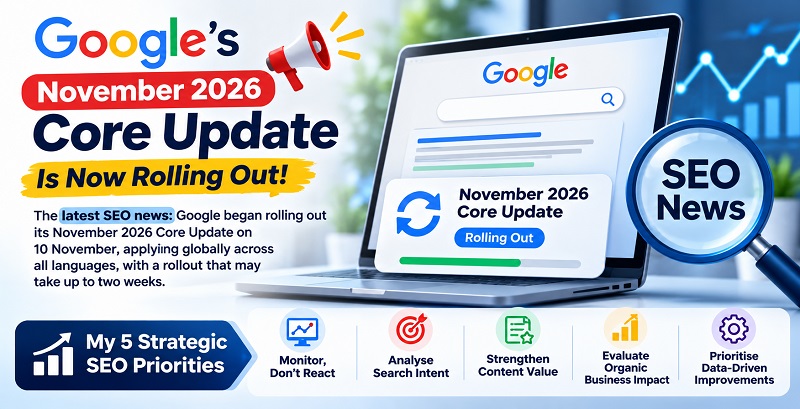
Google has officially started rolling out its November 2026 Core Update, introducing another significant development in the latest SEO news. The update began on 10 November 2026 and is being implemented globally across all languages, with the rollout expected to take up to two weeks.
For website owners, digital marketers and SEO professionals, this announcement raises important questions about search rankings, organic traffic, content quality and long-term search visibility.
However, Google’s core updates should not automatically be viewed as a threat to website performance. They are part of the search engine’s ongoing efforts to deliver more relevant, reliable and satisfying results to users.
The most important consideration is not whether rankings fluctuate during the rollout, but how businesses interpret those changes and respond with informed, sustainable SEO improvements.
In this article, we explore the latest Google algorithm update, what it means for organic search performance, how to identify potential impacts and five strategic priorities for maintaining a resilient SEO strategy.
What Is Google’s November 2026 Core Update?
The November 2026 Core Update is a broad adjustment to Google’s core ranking systems.
According to Google’s official Search Status Dashboard, the update began on 10 November 2026 at 10:06 a.m. Pacific Time, applies worldwide and may take approximately two weeks to complete.
As of 14 November 2026, the rollout remains active.
Unlike updates specifically addressing spam or certain search features, core updates involve broader changes to how Google’s ranking systems evaluate and prioritise content across search results.
Google’s objective is to improve the quality and relevance of information presented to searchers as available web content and user expectations evolve.
This means websites may experience changes in keyword rankings, search impressions, click-through rates and organic visibility.
However, not every website will experience a significant impact.
Some websites may gain visibility, others may experience declines, and many may remain relatively stable.
Importantly, Google has not announced any specific new ranking factors, targeted industries or individual website categories for the November 2026 Core Update.
Consequently, claims that the update specifically penalises AI-generated content, targets a particular industry or introduces an entirely new ranking factor should be treated cautiously unless supported by official information.
Why the Latest SEO News Matters for Website Owners
Google Search plays an important role in connecting businesses with potential customers who are actively searching for products, services and information.
Even relatively small changes in organic visibility can influence website traffic, lead generation and revenue.
For example, a business ranking prominently for commercially valuable keywords may experience fewer enquiries if competing pages begin receiving greater visibility.
Similarly, an informational website could experience increased exposure if its content becomes more competitive for relevant searches.
However, a ranking fluctuation does not necessarily indicate that the website has violated Google’s policies or that its previous SEO work was ineffective.
Core updates reassess the relative positioning of content within search results. A page that moves down may still provide valuable information, but competing pages may now be considered more suitable for particular searches.
SEO professionals should therefore distinguish between temporary fluctuations, sustained performance changes and broader business trends before deciding whether corrective action is required.
The latest SEO news reinforces an essential principle: successful SEO depends on understanding search intent, delivering genuine value and measuring outcomes rather than reacting to every algorithm movement.
Five Strategic SEO Priorities During the November 2026 Core Update
1. Monitor Google Search Performance Without Making Reactive Changes
The first priority is maintaining accurate visibility into search performance throughout the rollout.
Google Search Console provides essential information about how websites appear and perform in Google Search.
During the update, monitor organic clicks, impressions, average search position and click-through rate.
Pay particular attention to significant changes affecting important landing pages and commercially relevant search queries.
It is also useful to distinguish between branded and non-branded searches, as these can behave differently during periods of ranking volatility.
For example, a reduction in branded impressions may reflect changes in brand demand, while declining non-branded visibility across specific service pages could indicate a change in their search competitiveness.
However, daily ranking movements should not immediately trigger major content revisions, URL changes or large-scale website restructuring.
Google recommends waiting at least one full week after a core update has finished rolling out before conducting a detailed Search Console comparison.
Strategic recommendation: Monitor performance during the rollout, document unusual changes and postpone major ranking-related decisions until sufficient post-update data becomes available.
2. Analyse Search Intent and Landing Page Relevance
Search intent remains an essential consideration in effective SEO.
A website may contain the correct target keywords while still failing to deliver the information or experience users expect.
For example, someone searching for “best dental implants” may want treatment comparisons, benefits, costs and information about suitability.
A landing page that provides only a short promotional message may not adequately address those expectations.
Similarly, a search for the latest SEO news should lead to timely, accurate information about recent developments rather than outdated advice presented as current information.
SEO professionals should review whether their important landing pages:
- Answer the primary question behind the search query.
- Provide sufficient information for the user’s stage in the decision-making process.
- Present clear, accessible and well-organised content.
- Offer relevant supporting information and useful next steps.
- Align their page titles, headings and content with the intended topic.
Search intent analysis should also consider the current search results.
If the pages ranking prominently for a keyword have a different format or level of detail, this can provide useful insight into how the topic is being presented to searchers.
Strategic recommendation: Prioritise search intent alignment and genuinely useful information rather than increasing keyword frequency simply to influence rankings.
3. Strengthen Content Quality, Originality and Credibility
Google consistently recommends creating helpful, reliable, people-first content.
This principle remains relevant regardless of whether a core update is currently rolling out.
Website owners should assess how effectively their content provides original information, credible insights, accurate explanations and practical value.
Content quality is not determined simply by word count or keyword density.
A shorter article that answers a specific question accurately may be more useful than a lengthy page filled with repeated information.
Likewise, a detailed guide can deliver greater value when the topic requires substantial explanation.
Experience, Expertise, Authoritativeness and Trustworthiness, commonly referred to as E-E-A-T, provide a useful framework for evaluating content credibility. E-E-A-T itself should not be treated as one standalone Google ranking factor.
Businesses can strengthen content trustworthiness through identifiable authorship, relevant professional expertise, credible sources, transparent business information and accurate, regularly maintained content.
Original examples, case studies and first-hand insights can also help differentiate a website from competing resources.
For content published in specialist fields such as finance, healthcare and legal services, accuracy and appropriate expert review are particularly important.
Strategic recommendation: Review important content for usefulness, factual accuracy, originality and credibility before considering large-scale rewrites or content removal.
4. Evaluate Organic Traffic, Engagement and Business Results
Keyword rankings are important indicators, but they do not provide a complete picture of SEO performance.
A website can maintain relatively stable search visibility while experiencing a decline in qualified enquiries.
Conversely, organic traffic may decrease while conversion quality improves.
For businesses, the more meaningful question is whether organic search continues to attract the right audience and contribute to measurable objectives.
Combining Google Search Console and Google Analytics 4 (GA4) provides a stronger understanding of performance.
Search Console helps identify which search queries and landing pages are gaining or losing visibility.
GA4 provides additional insights into what visitors do after arriving on the website, including engagement, important events, lead submissions and purchases where tracking is configured.
For example, if a service page experiences a decline in organic clicks but maintains its conversion volume, the business impact may be less severe than the traffic figures initially suggest.
Similarly, a significant decline in non-branded organic traffic combined with reduced qualified leads may require more detailed investigation.
Performance reviews should also account for seasonal patterns, marketing campaigns, changes in consumer demand and tracking issues.
This is especially important for businesses operating during the November and December retail period, when Black Friday and other seasonal promotions can substantially influence search behaviour.
Strategic recommendation: Evaluate SEO through organic visibility, qualified traffic, engagement and conversions rather than relying exclusively on keyword positions.
5. Prioritise Sustainable, Data-Driven SEO Improvements
After the rollout is complete and sufficient performance data becomes available, SEO teams can begin a structured evaluation.
The objective should be to identify meaningful opportunities for improvement rather than attempt to reverse every individual ranking movement.
Start by investigating the pages and keyword groups showing sustained, significant declines.
Compare their performance against relevant competitors, assess whether their content still satisfies search intent and identify opportunities to improve usability or technical accessibility.
Technical SEO should remain part of this evaluation.
Important considerations include indexability, canonicalisation, internal linking, mobile usability, page experience and the ability of search engines to discover and understand website content.
However, technical changes should address genuine issues rather than be implemented simply because an algorithm update has occurred.
If a website already has appropriate technical foundations, the greater opportunity may lie in improving content depth, topic coverage or user experience.
Google also explains that meaningful improvements may take time to affect rankings. Some changes can have an impact relatively quickly, while broader reassessments can take several months.
Strategic recommendation: Build an improvement roadmap based on documented performance issues, content opportunities, technical findings and business priorities.
How to Analyse SEO Performance After the November 2026 Core Update
A structured analysis helps distinguish genuine changes in organic visibility from normal search fluctuations.
Establish a Reliable Performance Baseline
Begin with Google Search Console data from the period before the rollout started on 10 November 2026.
Record important metrics for priority landing pages, search queries and search types.
Where possible, include historical comparisons to understand whether changes reflect an existing trend.
Wait for the Official Rollout Completion
Google has advised that the November update could take up to two weeks.
However, the expected duration should not be treated as a confirmed completion date.
Check the official Google Search Status Dashboard to establish when the rollout has finished.
Then allow at least one full week before conducting a detailed analysis, in line with Google’s recommendations.
Compare Equivalent Reporting Periods
Compare a full week after the rollout with an equivalent week before the rollout began.
Analyse Search Console clicks, impressions, average position and click-through rates alongside relevant GA4 organic traffic and conversion metrics.
Account for differences in seasonality, promotions and search demand when interpreting results.
Segment the Findings
Avoid treating every traffic movement as a sitewide algorithm impact.
Review important landing pages individually and group search queries by search intent, topic and branded or non-branded relevance.
Also distinguish between Google Web Search, image search and other applicable search types when investigating fluctuations.
Prioritise Findings Based on Business Impact
The most important changes are not always those with the largest ranking movements.
A small decline affecting a commercially valuable landing page may deserve greater attention than a larger decline affecting a low-value informational query.
Use this analysis to establish realistic priorities for future SEO work.
What Should Businesses Avoid During a Google Core Update?
Core updates can create pressure to make immediate changes, particularly when a website experiences an unexpected decline in search visibility.
However, changes made without sufficient analysis can introduce additional risks.
Businesses should avoid rewriting large volumes of content, deleting pages or restructuring URLs solely because rankings have fluctuated for a few days.
They should also avoid excessive keyword optimisation, unnecessary changes to internal linking and the assumption that every reduction in traffic is caused by the update.
Removing content should generally be considered only after assessing whether that content is genuinely unhelpful and cannot reasonably be improved.
It is equally important to avoid treating unverified claims about new ranking factors as official Google guidance.
A more effective approach is to maintain normal SEO monitoring, address independently identified technical issues and make evidence-based improvements that support users.
The Bigger SEO Lesson: Focus on Sustainable Organic Growth
The November 2026 Core Update highlights the importance of a long-term approach to search engine optimisation.
SEO is not simply about protecting existing keyword rankings.
It involves continually improving how effectively a website connects relevant information with the people searching for it.
Strong SEO strategies combine search intent, content quality, credible expertise, technical accessibility and measurable business outcomes.
They also recognise that search results are dynamic.
New competitors, changing customer expectations, emerging content formats and adjustments to search systems can all influence organic visibility.
Businesses that invest in meaningful improvements are better positioned to respond to these developments than those relying primarily on short-term algorithm tactics.
Remaining informed about the latest SEO news is valuable, but interpreting developments correctly and translating them into practical improvements is what creates lasting value.
Frequently Asked Questions About Google’s November 2026 Core Update
1. What is the latest SEO news about Google’s November 2026 Core Update?
Google officially began rolling out the November 2026 Core Update on 10 November 2026. The update applies globally across all languages and may take up to two weeks to complete. It involves broad changes to Google’s core ranking systems, intended to improve the relevance and usefulness of search results.
2. Can the November 2026 Core Update affect website rankings?
Yes. Core updates can affect how websites appear in Google Search results. Some pages may gain positions, others may decline and many may experience little noticeable change. However, ranking fluctuations do not automatically indicate that a website has violated Google’s policies.
3. How long will the November 2026 Google Core Update take?
Google has indicated that the rollout may take up to two weeks from its starting date of 10 November 2026. The exact completion date should be confirmed through the official Google Search Status Dashboard.
4. What should I do if my organic traffic drops during the update?
Monitor Google Search Console and GA4, but avoid making major changes based on short-term fluctuations. After the rollout finishes, wait at least one full week before analysing sustained changes in rankings, landing-page traffic and conversions. Investigate significant declines before deciding what to improve.
5. Does Google’s November 2026 Core Update specifically target AI-generated content?
Google has not announced that this update specifically targets AI-generated content. Its broader guidance focuses on the usefulness, originality, reliability and purpose of content. The important consideration is whether the content provides genuine value rather than whether a particular technology assisted in creating it.
6. How can I recover rankings after a Google Core Update?
There is no universal recovery procedure. Start by identifying pages and queries with sustained performance declines. Review search intent alignment, content usefulness, competing search results, technical accessibility and user experience. Implement meaningful improvements and continue monitoring. Recovery is not guaranteed, and changes may take time to influence rankings.
7. Should I change my SEO strategy after every Google algorithm update?
Not necessarily. A core update should encourage performance evaluation rather than automatic strategic changes. If a website is meeting user needs and generating measurable business results, its existing SEO direction may remain appropriate. Adjustments should be supported by reliable data and clear improvement opportunities.
Conclusion: The Latest SEO News Reinforces a Long-Term SEO Approach
Google’s November 2026 Core Update is an important development for businesses, marketers and website owners, but it should not create unnecessary urgency or panic.
Ranking movements are a normal part of Google’s ongoing evaluation of search results.
The priority should be understanding whether changes are temporary or sustained, identifying where search performance has genuinely changed and making improvements that benefit website visitors.
By combining Google Search Console, GA4, content evaluation and technical SEO assessments, businesses can make better-informed decisions about organic search performance.
The most effective SEO strategy is not built around reacting to every Google algorithm update. It is built around consistently delivering relevant, trustworthy and useful experiences that support real business objectives.
Stay informed about the latest SEO news, monitor meaningful performance indicators and invest in sustainable improvements that support long-term organic growth.

Leave a Reply
You must be logged in to post a comment.